How to organize your wedding guest list when both families are huge
A complete guide to building your guest list when both families are huge. Prioritization methods, how to negotiate, and how to avoid fights.

There's a stage in planning almost every wedding that no one enjoys and every couple underestimates: building the guest list.
And when both families are large — with lots of aunts, second cousins, goddaughters and "people who have watched you grow up your whole life" — this task becomes the most emotional part of the entire process. Fights you didn't see coming appear, pressures you never anticipated pile up, and you're forced into hard decisions you'd rather not have to make.
In this article we give you a practical, emotionally sustainable framework for building your list when both families seem to have more people than your budget can handle. With concrete methods, how to talk to your parents without hurting anyone, and how to manage the list once it's closed.
🔢 Start with the number, not the names
Almost every couple makes the same mistake: they start building the list before knowing how many people it can hold. The result is a list of 300 people that later has to be cut down, painfully.
Before you write the first name, define the real maximum number your wedding can support. That number comes down to three things:
- Your budget. How much you'll spend per guest (venue + catering + drinks + per-table decor). Multiply it by the maximum number you can cover.
- The venue's capacity. Even if you have the budget, if the space fits 120 you can't cram in 180.
- The kind of wedding you want. Do you prefer an intimate wedding where you greet every guest, or a big one where you greet whole blocks at a time? That decision is valid — but it defines the final number.
Once that number is clear, the rest of the process stops being an abstract conversation and becomes an arithmetic decision. "We're 100 people max. We have to choose 100."
💡 Nupcii Tip: If you're not yet clear on how much you can spend per guest, start with our budgeting guide using the 50/30/20 formula. Without that number, you're building the list on thin air.
📆 The "have I seen them this year" rule
To quickly filter down an oversized list, there's a method used a lot by wedding planners that works incredibly well:
If you haven't seen that person in the last year (outside of weddings, funerals or obligatory occasions), they probably shouldn't be at your wedding.
It's not a hard rule — there are legitimate exceptions (people who live far away, deeply loved relatives where the bond runs deeper than the frequency). But as an initial filter, it easily eliminates 30-40% of an inflated list.
The logic behind it is simple: your wedding is one of the most intimate events of your life. Surrounding yourself with people you have a living relationship with gives the day a meaning you'd never get from a room full of people you don't recognize.
🎯 The A, B, C method: visual prioritization
After the "this year" filter, the list is still too long for almost every couple. Here it works really well to sort each name into three categories:
🟢 Category A — Non-negotiable
People who, if they didn't come, there would be no wedding. Parents, siblings, best friends, grandparents, godparents if applicable. This block doesn't get touched. It's usually between 20 and 40 people.
🟡 Category B — Important
Close people you want there, but whose absence wouldn't break your heart. College friends, close cousins, aunts and uncles you have an easy relationship with, coworkers who are genuine friends. Usually between 40 and 100 people.
🟠 Category C — Optional
People you'd invite if your budget allows, but who — if you have to cut — can be left out without much harm. Everyday work colleagues, second cousins, friends of friends, guests invited out of family obligation. This is the block that comes in and goes out depending on how much room is left over after A and B.
This classification has two benefits: it gives you a clear mental map and it lets you prioritize by blocks instead of arguing person by person.
📸 
👨👩👧 How to divide the list between both families without fights
This is the most delicate point. And the honest solution is one: the list does not automatically split 50/50. It splits based on three factors:
1. Relative size of each family
If one side's family is large (12 aunts and uncles, 45 cousins) and the other is small (2 aunts and uncles, 5 cousins), pretending that "each family brings 40 people" is artificial. The distribution should be proportional to the real size.
2. Who pays for what
In some Latin American families, tradition holds that the bride's parents cover a big part of the wedding. When one family contributes more financially, they culturally tend to have the right to invite more people. Clear this conversation up from the start — it saves you a lot of friction.
3. The three-lists rule
Many Latin American wedding planners recommend a scheme of three separate lists that are later consolidated:
- The couple's list
- The groom's family's list
- The bride's family's list
Each list gets a maximum quota assigned according to the factors above. Each block negotiates internally about who to prioritize within its quota. When it's time to consolidate, everyone knows their list has already been filtered.
This method avoids the feeling that "one side" is imposing itself. Each family takes responsibility for its own selection.
💬 How to talk to your parents about the quotas
This tends to be the hardest conversation in the planning. Some approaches that work:
Be clear on your number before the conversation
Don't walk into the talk without knowing how many total guests you can host. If you show up with "we have to cut" but no final figure, the conversation drags on and goes nowhere.
Explain the framework before talking about specific people
Start by presenting the budget, the venue's capacity and the maximum number. When your parents understand the real constraint, the conversation stops being emotional and becomes mathematical.
Propose quotas, not vetoes
It's easier to say "we have 40 spots for your family" than "we're not inviting Aunt Marta". Let them decide who to prioritize within the quota — they'll own the decision better.
Accept that there will be tension
Even if you do everything right, there will be awkward moments. Some aunt will get upset, some cousin will feel left out. It's part of the process. No wedding ends up perfect for everyone involved — and it doesn't have to.
💍 The famous "plus one": when yes and when no
Another source of debate is which guests bring a companion and which don't. This is a convention that works well at most Latin American weddings:
Gets a plus one:
- Married couples or people in stable relationships (even if you don't know them well)
- Engaged people or those in a public relationship of 6+ months
- Key guests (godparents, witnesses) attending alone
No plus one by default:
- Single cousins, colleagues or friends — unless they check with you in advance
- People who live nearby and have their own circle at the wedding
- Guests you don't have a close relationship with
Communicate it clearly in the invitation. If the guest has spots, the invitation tells them. If not, it doesn't either. Avoid ambiguity — that's where conflicts are born.
🛟 The B-list: your silent lifesaver
This is a little-known but very effective trick. When you close your main list, also build a replacement B-list with 10-15 people you'd invite if someone from the A-list cancels.
In Latin America, the cancellation rate runs around 10-15% of the total invited. With a B-list ready, you can send out invitations as you confirm cancellations — without leaving spots empty and without permanently excluding people you love.
💡 Nupcii Tip: B-list invitations go out at least 2 months in advance, not two weeks before. No one wants to feel like an afterthought. With two months, the feeling is completely different.
👶 Children: to include them or not
This is another decision that lights up family conversations. The options are:
"Adults only" wedding: no children invited (except the couple's own if applicable). It's a growing trend in Latin America, especially for evening and formal weddings.
Wedding with children: all the family's kids are welcome. It requires planning a kids' area, an adapted menu and babysitters.
Only specific children: the children of your closest guests come, the rest don't. It's the hardest option to communicate — it can cause hurt feelings.
Whatever you decide, communicate it clearly in the invitation and with tact. Something like "This wedding is a special night for adults — we appreciate your understanding and arranging care for the little ones" works much better than a cold "no children allowed."
💼 The "obligatory" guests: boss, business partners, colleagues
In many professional circles there's pressure to invite the boss, business partners or key clients. Here's the honest rule:
If you wouldn't invite them to dinner at your home, don't invite them to your wedding.
Your wedding isn't a networking event. If you have an easy, good working relationship — yes, invite them. If it's a purely contractual relationship, send them a nice note after the event with a photo. Almost no one gets offended by not being invited to someone else's wedding; many get annoyed by feeling obligated to go.
If you truly need to invite them out of real political pressure (a call only you can make), group them at the same table to minimize the emotional energy they require during the night.
📊 Excel vs. digital system: how to manage the list
Almost every couple starts with Excel. And for weddings of fewer than 50 guests, Excel can be enough. But when we're talking about large families (150+ guests with multiple families, quotas, categories and confirmation statuses), Excel starts to struggle.
What Excel does well
- Sorting and filtering by any column
- Sharing the file with your partner
- Being free and familiar to everyone
What Excel does badly
- It doesn't update in real time across devices
- Guests can't confirm directly — you have to enter the data manually
- It doesn't integrate with the invitation (they're two separate systems)
- If you and your partner update it at the same time, you end up with two versions
- It doesn't send reminders or make follow-up easy
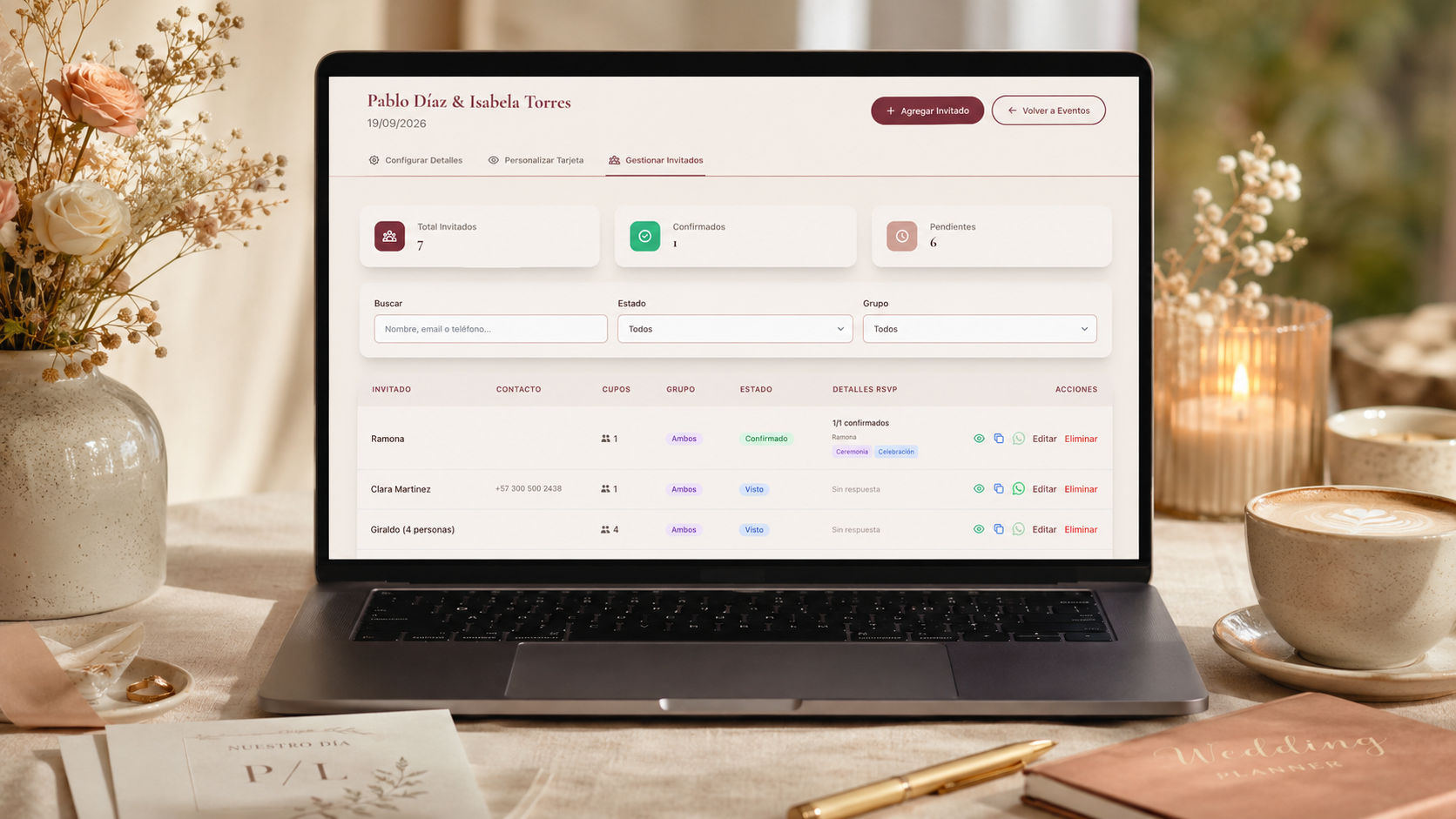
For large lists, a digital system integrated with your invitation solves all of that. Guests open their link, confirm, and their reply appears in your dashboard instantly — with nothing to transcribe. If you've never used one, see how digital RSVP works and why it changes everything.
📸 
🏷️ How to structure the digital list when families are large
When your list passes 150 guests, the way you organize it inside the system makes a huge difference. Three practical tips:
1. Tag each guest by family block
Bride's family, groom's family, bride's friends, groom's friends, colleagues, others. Being able to filter by block helps you follow up without chaos.
2. Use the right invitation type
- Individual — for guests attending alone
- Person + spots — for those bringing a companion (Juan + 1)
- Family with spots — for family groups (The Pérez Family — 5 people)
Choosing the right type from the start saves you from having to re-edit links later.
3. Flag the key guests
Godparents, witnesses, immediate family. When it's time to follow up (the month before the wedding), these are the ones you absolutely need to confirm. An internal flag helps you tell them apart.
🕊️ How to close the guest-list chapter without guilt
One last point that gets underestimated: closing the list is an emotional act. You're going to feel guilty for not inviting someone, or for inviting too many. Both are normal.
Three reminders that help you let it go:
- Your wedding is yours. Not your parents', not your in-laws', not your social circle's. The guests who are there should be there because you chose them.
- Not inviting someone isn't rejecting them. It's a decision of context, not of bond. Most people understand that weddings have limits.
- The quality of your guests defines the quality of the wedding. Ten people who celebrate with their whole soul are worth more than a hundred watching the clock.
⚠️ Common mistakes when building the guest list
After seeing hundreds of weddings, there are patterns that repeat. The four most frequent:
1. Starting the list without defining the per-guest budget
It's the most common mistake. It produces inflated lists that later have to be cut, painfully.
2. Not involving your partner from the start
When one person builds the list alone and the other sees it late, avoidable friction shows up. Get involved together from day one.
3. Sending the invitation before fully closing the list
Many couples send to "a first block" and plan to add more later. In practice, this creates confusion and comparisons ("why did she get an invitation before me?").
4. Relying on memory alone for follow-up
With large lists, it's impossible to remember who confirmed, who's missing, who said "I'll let you know." A system that shows you updated statuses is the difference between management and chaos. If you want to keep this follow-up organized within the wedding's overall timeline, lean on our month-by-month checklist.
📋 In summary
To build the guest list when both families are huge:
- Define the real maximum number first based on budget, venue and type of wedding
- Apply the "have I seen them this year" filter to quickly eliminate the obvious
- Sort each name into A / B / C to prioritize by blocks
- Split by quotas, not vetoes — give each family a quota and let them decide internally
- Have a B-list ready to replace cancellations
- Clearly define children and plus ones — communicate it in the invitation
- Use an integrated digital system when the list passes 100 names
- Let go of the guilt when you close it — your wedding is yours
Building the list is one of the most emotional stages of planning, but with a clear framework it becomes far more manageable — and the conversation with family stops being tense and turns into a series of practical decisions.
✨ Conclusion
When both families are large, a free plan with a guest cap runs out fast. With Nupcii's Celebración plan ($19 USD, one-time payment) you get:
- Unlimited guests — no matter how big your list is
- All invitation types (individual, family with spots, person + spots)
- Real-time RSVP with a dashboard shared between the couple
- Direct sending over WhatsApp with a pre-written message
- Instant updates to details if something changes — nothing to resend
- Email notifications every time someone confirms
- Direct human support
You pay once, no subscription, and the event is yours forever. Ideal when the list passes 100 names and you need serious tools to manage it without chaos. If you don't have your digital wedding invitation set up yet, start free and join the 600+ couples already using Nupcii.
📸 
✨ Because the perfect list isn't the longest one — it's the one full of the people who'll celebrate with their whole soul.
Ready to create your invitation?
Start free today. No credit card required.
Create my invitation for free